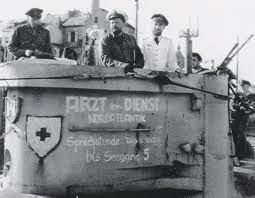
Ahi va la respuesta...
Se trataba de descubrir el
block runner Rhakotis, nombre que recibia la ciudad que escogio Alejandro Magno en el delta del Nilo como capital de su imperio...Alejandria.
La historia aparece en ubootwaffe y es un recuerdo a Hans Gerisch de su hijo.
El comandate Kurt Sturm lideraba un grupo de tres submarinos que debian escoltar al cargero Rhakotis.
El submarino de Sturm era el U-410.
El Rhakotis llevaba como pasajero al hijo del embajador japones en Alemania.
Ubootwaffe.com
(esta es la vision "alemana")
"On 02.01.43 we were going, so I believe, with 3 other U-boats to the Azores. The order command was to escort the cargo ship which was called "Rhakotis". Commander Sturm was the leader of the of the U-boat-group. It was the time between Christmas and New Year, because we had baken pancakes.
We (U410) were going in front of the uboat-group, the 2 other boates were right and left on our broadside, one boat took the rule as a safety device. This last boat a time later operated on one's own initiative ( or get a new order). Than came the "Rhakotis" and was owing to enemy tough sink, because the last boat left his position. The crew of the "Rhakotis" went into lifeboats and we had to rescue the 80 mens. We were 50 crew-members and had hardly room for us ourselves.
Among the 80 survovors were 1 or 2 english men. They got a special guard. With the totally full boat we went through the Biscaya. Our 4 tube anti-aircraft gun was defective and had been to repair above water. In one of the life boats was the son of the japanese ambassador in Germany. He had a suitcase with valuable documents in his hands. During the taking over of the rescue was a considerably heavy sea. The boats rolled on the left and right hand side. The japanese son should throw the suitcase from the rescue boat to our U410. He done that, but in this moment U410 drifted away due the high waves. The valuable siutcase fell and sank in the water.
In all departments of our boat the rescued mens were accomodated. In my E-room-section were 6 persons! One of them was a danish man. When I was detached in September 1943 from U410 to U385 (which was situated in Bergen Norway) I went by a steamer boat to Bergen. On this crossing I met these danish men again. He was there the boatswain. During the crossing he stowed me away in his cabin."
uboat.net (la aseptica)
1 Jan, 1943
The German blockade breaker Rhakotis (6753 BRT) is intercepted by the British light cruiser HMS Scylla (Capt. I.A.P. Macintyre, RN) some 200 miles north-west of Cape Finisterre in position 45.01N, 10.50W. When the British open fire the Germans scuttled their ship.
http://www.warsailors.com/raidervictims/michel.html (vale la pena leer el texto completo de la odisea de los prisioneros a bordo del Rhakotis)
Then someone called down to us that a warship was approaching, but we could take it easy because that was German too. No sooner had the words been uttered, than the first round of shells started coming, and we realized it was an allied ship (this was HMS Scylla). One round after another followed, several hit. 2 loads of explosives in boxes had been situated in front of No. 3 hatch and we could now hear them being hung, one on each side of the ship.
The minutes dragged on, and we wondered if we were meant to go to the bottom. Finally orders came to head for the lifeboats and we bolted up the stairs. As I passed a door leading out to deck I saw the flashes and the smoke coming from the warship. Several boats had already been launched by the time we got on deck. Many of us jumped overboard and the Germans helped us into the lifeboats. Rhakotis was already on fire. The only people I could see still on board were the captain and the 1st mate, but they also jumped overboard and we fished them up into our boat. After the lifeboats had gotten away from Rhakotis the cruiser kept shooting something awful; not one shot missed. The whole ship was on fire, and bits of wood and iron were flying across the water. A torpedo also hit, and soon afterwards she took on a list and quickly sank. Right next to us was a 4 inch gun floating in the water, so it was just made of wood. All 4 lifeboats were on the water, and it was horrible being there. More and more people entered the boat, and it was all we could do to keep it afloat. All the time we expected the cruiser to come and pick us up, but no, we were thoroughly disappointed; it zig-zag'ed away into the dark".
Among those in the lifeboat were Captain Gjurød, the radio operator and an able seaman. At 7 o'clock that evening several aircraft flew over them and dropped some red flashes. They signalled back to them but they disappeared in the dark. The next morning the weather improved and they set sail, heading towards the coast of Spain. On Jan. 3-1943 at 11 in the morning they saw land, and at 3 in the afternoon a Spanish trawler picked them up and landed them at Corona. They arrived at 10 in the evening and were met by many Germans who took very good care of them, seeing to it that they got a good meal and a bed to sleep in. 2 lifeboat crews came to Corona, Kattegat's 1st Mate, Rolf Christiansen landed in Spain in the 2nd boat the next day. On Jan. 4 the captain got a hold of the British consul who helped them in every way and sent them on to Madrid. From there they travelled to Gibraltar and on to Gt. Britain, arriving Glasgow on Febr. 1-1943, where they could finally spread the word on what had happened to the missing Norwegian ships. (Rolf Christiansen later died in another war related incident outside London).
The people in the other 2 lifeboats had been picked up by a German U-boat. Among them were 6 Norwegians who subsequently ended up in France, probably St. Nazaire, Kattegat's 2nd mate being 1 of them. Among the 6 was Ordinary Seaman Hans Gustav Espeland, who had escaped from Norway to Shetland, then on to Aberdeen with 16 other men on the fishing boat Fiks (SF 334 SU) on Oct. 11-1941, and later taken to London where he had joined Kattegat. After a few days in France the survivors from Kattegat's crew were sent to Marlag und Milag Nord, but by the spring/summer of 1943 they had been released and were back in Norway, having travelled by train via Hamburg to Århus, Denmark. For the last leg they got passage on the troop ship Monte Rosa, known for her transport of Norwegian prisoners from Norway to Denmark, en route to German concentrations camps. Hans Gustav Espeland would ordinarily have gotten into big trouble (probably shot) upon his return to Norway, because of his previous escape to England, but just as the policeman was on his way to the Gestapo headquarters with the report on him, 2 men belonging to the underground resistance movement intercepted and shot the policeman.
Captain Gjurød later wrote to Nortraship: "Permit me to mention Kattegat's 1st Mate Rolf Christiansen who proved himself a real sailor in time of danger. Likewise Ordinary Seaman Olaf Aas, who got through the rain of bullets and up on the boatdeck to turn on the lights to the lifeboats. As a result the shelling from the raider stopped".
With regard to the 1st mate, the author of the booklet that I've quoted from here, Harald Nicolaisen says he spoke with him in London during the war. Christiansen told him that more than once they had planned a revolt while on Speybank en route from No. 28 (Michel) to Japan. The plan was to overrun the guard in such numbers that he wouldn't be able to shoot all of them down. What made them decide against this plan was the machine guns mounted on each side of the ship.